The Four O'Clock Sun: Six Coastal Cottages That Make the Most of a Short Winter Day
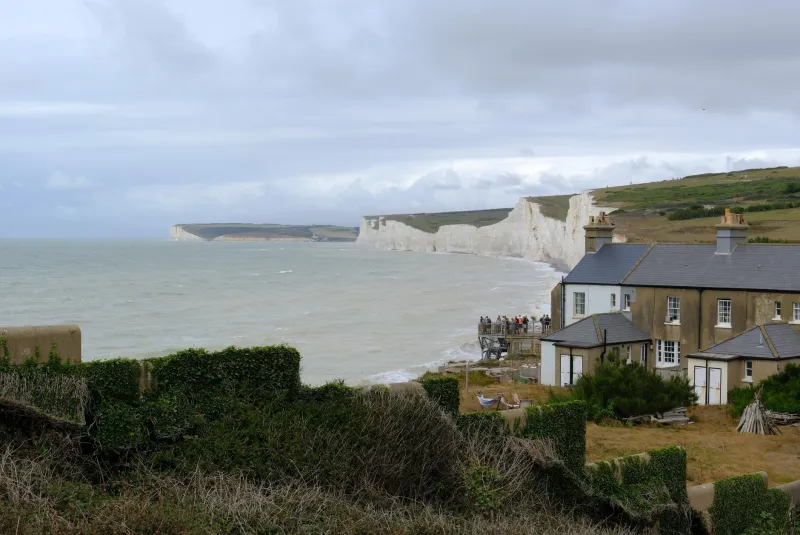
There is a moment, somewhere around three in the afternoon in mid-December, when a good winter cottage suddenly explains itself. The sun has dropped to the height of a church roof, it comes straight through the window at an angle no summer afternoon could manage, and the whole room turns the colour of weak tea. Ten minutes later it is gone. Whether you get that moment or not depends almost entirely on things you can check before you book.
In July, a sea view is a nice-to-have. In January, light is the currency. Here is how to spend it well.
Why the low sun changes everything
At midday in late December the sun sits only around fifteen degrees above the horizon in southern England, and lower still in Scotland. That has three consequences worth knowing.
First, low light travels. It slips under the eaves and deep into rooms, which is why a modest window facing the right way can outperform a huge one facing the wrong way.
Second, it is easily blocked. A leylandii hedge, a hillside to the south, the gable of the cottage opposite — none of these register in a summer listing photograph, because in June the sun is high enough to clear them. In winter they decide your afternoon.
Third, it moves in a short, shallow arc. In practical terms that means an east-facing room is bright until about eleven and then quietly gives up; a south-facing one holds light most of the day; a west-facing one is dull in the morning and rewarded after two o'clock, often spectacularly.
Read the listing like a light map
Before you fall for the photographs, do three unglamorous things.
Open the listing images and look at the windows rather than the view. Are they deep-set and small, or wide and low? A low sill facing south will catch a winter sun that a high cottage window never sees.
Then open an Ordnance Survey map of the address and look south. Is there a wood, a headland, a church tower? Anything that shades the cottage between eleven and two is shading the best hours of the day.
Finally, ask the owner directly. Hosts who know their cottage will tell you without hesitation which rooms are bright in winter, and which are not. Their answer tells you a good deal about the cottage and about the host.
Six coastal stays that earn their winter keep
These are area guides rather than specific bookings — the point is what to look for in each place.
A stone steading behind Embleton Bay, Northumberland. Look for converted farm buildings with a glazed gable end facing south across open fields. Big Northumbrian skies mean the sunset is the event of the day, and the darkness afterwards is genuinely dark, which is half the appeal of a winter week up here.
A cliff cottage above the Pembrokeshire coast, near Abercastle. West-facing windows and a glazed porch are the things to hunt for. The porch matters as much as the window: it is somewhere to sit out of the wind at two in the afternoon with a mug and a coat on, watching the light come in off the Irish Sea.
A marsh-edge cottage near Walberswick, Suffolk. Go the other way here and book for sunrise. An east window over the reeds gives you a long, pale, spectacular morning, and the trade-off — an early dusk — is worth it if you like lamplight, board games and a fire by four.
A fisherman's cottage in Crail or Cellardyke, East Neuk of Fife. What you want is a walled garden or a sheltered back court facing south, ideally with a bench and a bit of stone wall to stop the wind. In the East Neuk the sea is often fierce and the sun trap behind the house is where winter afternoons actually happen.
A flint cottage at Thornham or Burnham Overy, north Norfolk. West-facing over saltmarsh, with a low sun that turns the creeks copper at about ten to four. Look for somewhere with a path to the marsh that does not involve a road, so you can walk out for sunset and be back before the dark properly lands.
A net loft above the harbour at Mousehole, Cornwall. Harbour-facing rather than sea-facing is the trick. Water bounces light back into the room even when the sun is behind a cloud, and the quay gives you a sheltered, level walk when the coast path is greasy.
Timing walks around a very short day
In the winter of 2026–27, sunrise on the UK coast lands somewhere between about 7.50 and 8.35 depending on how far north and west you are. Sunset is earlier than most people expect: roughly 15.50 in Norfolk in mid-December, closer to 16.20 in west Cornwall in early January.
So build the day around the middle. Ten until two is your window for anything ambitious — a headland, a beach walk with a hill in it, the bit of coast path with the stile. The hour before sunset is not really an hour in winter; the sun hangs low and golden for most of the afternoon, which is lovely for photographs and terrible for losing track of time. Take a torch even for a short walk, and take it seriously on cliff paths, which go dark under the land well before the sky does.
And do check the tide table alongside the sunset time. A beach that is a gentle evening stroll in August can be a different proposition at four in the afternoon in December.
Five questions to ask before booking
- Which windows face south or west, and which rooms do they belong to?
- Is there a sheltered outdoor seat, and is it out of the prevailing wind?
- Is the path from the door lit, and is there a torch in the hall?
- Is there a porch or boot room where wet coats are not a problem?
- What is within a ten-minute walk that is lit, or at least not pitch dark, in the evening?
The best winter cottage is rarely the one with the biggest view. It is the one where, at three in the afternoon, you can put down your cup of tea, look up, and watch the light do something worth watching.